
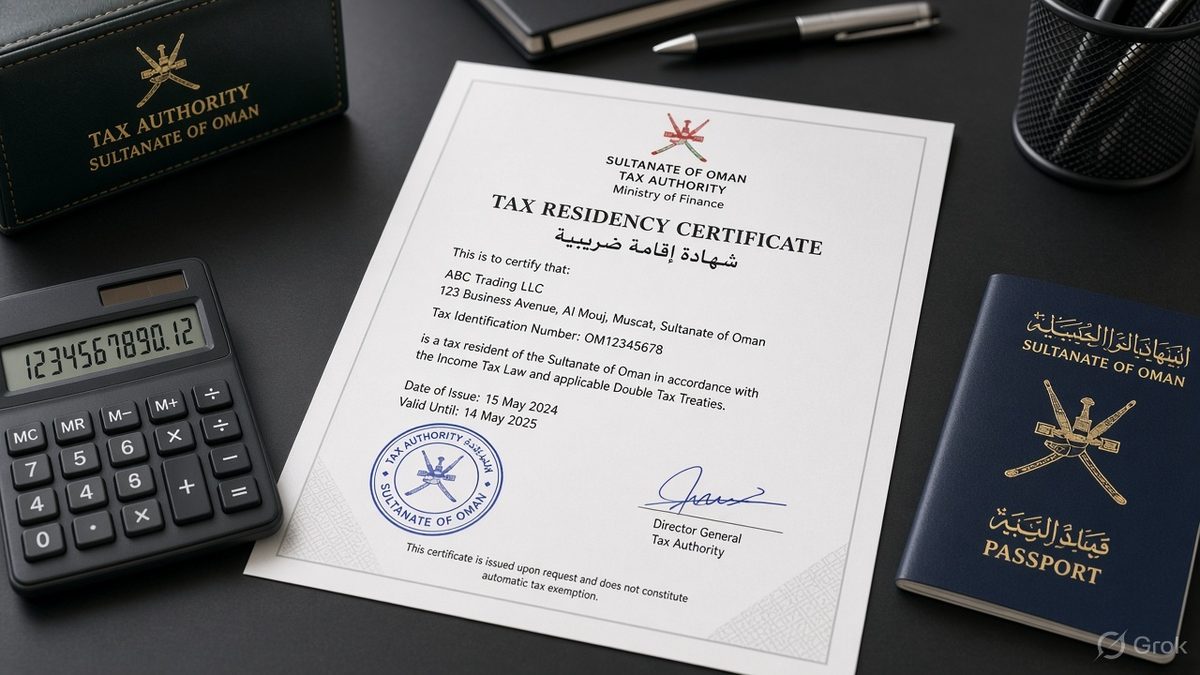
Global mobility, strategic location, and business-friendly reforms have accelerated interest in the Sultanate of Oman as an attractive long-term residence and investment destination. For many foreign nationals, expatriates, and corporate entities, establishing a base in Oman brings significant lifestyle and commercial advantages. However, as international travel and cross-border assets expand, so do regulatory complexities.
Someone may hold an Oman residence permit, own luxury real estate, manage a commercial enterprise, or spend substantial time within the country. But does that automatically make them a tax resident? The short answer is no. Establishing lawful immigration status does not instantly settle one's domestic tax status or satisfy foreign tax administrations.
For high-net-worth individuals, entrepreneurs, and global corporations, obtaining an official Oman tax residency certificate has become a vital step in formalizing cross-border financial and tax documentation. To navigate this landscape cleanly, you must separate three distinct legal concepts:
Immigration Residency: Lawful permission to enter, live, and reside in the Sultanate (such as meeting Oman Golden Visa residency requirements).
Tax Residency: A substantive status determined under domestic tax legislation or treaty provisions based on physical presence, habitual residence, or legal incorporation.
Tax Residency Certificate (TRC): An official evidentiary instrument issued by the government confirming tax resident status for a specific tax year or purpose.
To facilitate formal proof, the Oman Tax Authority provides dedicated certificate services for eligible natural persons and registered legal entities.
What Is an Oman Tax Residency Certificate?
Definition of a Tax Residency Certificate
An Oman tax residency certificate (also known as a tax residence certificate) is a formal administrative document that attests to the tax domicile and residence position of a taxable person within the Sultanate of Oman. The certificate confirms that, for a designated tax year or specific assessment period, the applicant satisfied the statutory residence criteria under domestic tax legislation or an applicable double taxation treaty.
Because international tax rules operate strictly on periodic reporting, the relevant tax period stated on the certificate is paramount. A certificate valid for one tax year does not permanently establish continuous residency for future periods; it serves as point-in-time proof of compliance and physical presence.
Who Issues the Oman Tax Residency Certificate?
The certificate is issued solely by the Tax Authority of the Sultanate of Oman, which functions as the country’s competent authority for tax administration and international tax matters. Applications are processed through dedicated digital government portals, distinguishing between individual filers and corporate enterprises through targeted services for individual certificate issuance and taxpayer or company certificates.
What Is the Purpose of the Certificate?
A tax residency certificate is designed to serve as formal, legal verification in cross-border administrative and financial dealings. Common purposes include:
Supporting tax residence claims: Providing conclusive proof of tax domicile when dealing with home-country revenue services.
Accessing double taxation treaty procedures: Supplying mandatory documentation to foreign revenue departments to claim reduced withholding tax rates or tax treaty benefits.
Satisfying institutional compliance: Furnishing verifiable proof to foreign and domestic banking institutions requesting formal tax identification during enhanced due diligence.
Facilitating cross-border financial administration: Substantiating corporate residence when moving dividends, royalties, or management fees between international entities.
Crucial distinction: An Oman tax residency certificate is formal evidence of residence under Omani standards; it is not a unilateral, universal exemption certificate against foreign tax obligations.
Individual vs Company Tax Residency Certificate
The Oman Tax Authority maintains distinct procedural tracks depending on the legal classification of the applicant:
Natural Persons (Individuals): Focused on physical presence thresholds (such as the 183-day rule), lawful immigration status, local economic ties, and proof of an actual residential address.
Legal Persons (Companies & Corporate Entities): Focused on statutory incorporation within Oman, the location of effective management, active commercial registration, and corporate tax compliance records.
Tax Residency vs Immigration Residency in Oman: What Is the Difference?
Conflating immigration permission with tax residence is one of the most common pitfalls for international investors relocating to the Middle East.
What Is Immigration Residency?
Immigration residency grants a foreign national the legal right to enter, stay, and live in the Sultanate of Oman. It is evidenced by a visa sticker, digital permit, and an official Civil Status Residence Card issued under Royal Oman Police regulations. Whether through an employment visa, company sponsorship, or long-term investor permissions under Oman Golden Visa eligibility requirements, immigration status governs border control and right of abode—not tax liability.
What Is Tax Residency?
Tax residency is a substantive legal classification governed by domestic tax legislation and bilateral tax conventions. It determines whether a person or entity falls within the jurisdiction's tax framework for a specific tax year. For individuals, it is heavily dictated by continuous or intermittent physical presence, centre of vital interests, and habitual residence. For companies, it hinges on registration, tax identification numbers, and place of central management.
What Is a Tax Residency Certificate?
A tax residency certificate is neither a visa nor a residency card. It is a formal certification produced after an administrative review by the Tax Authority, certifying that the applicant has satisfied the statutory conditions of tax residence for the period in question.
Comparison: Immigration Residency vs Tax Residency vs Tax Residency Certificate
| Factor | Immigration Residency | Tax Residency | Tax Residency Certificate |
|---|---|---|---|
| Governing Authority | Royal Oman Police / Ministry of Labour | Oman Tax Authority & International Treaties | Oman Tax Authority |
| Primary Document | Residence Card / Visa Stamp | Domestic Tax Law / Treaty Definitions | Formal Certificate of Residence |
| Core Determination | Investment, property, employment, sponsorship | Physical presence days, economic ties, corporate seat | Verified documentary review for a specific period |
| Primary Purpose | Lawful entry, right to live and work locally | Allocation of domestic and global taxing rights | Formal proof presented to external authorities/banks |
| Renewal Cycle | 1, 2, 5, or 10 years depending on visa tier | Evaluated annually per tax year | Issued per application/specific tax year |
Does an Oman Golden Visa Automatically Make You a Tax Resident?
No. Holding an Oman 5-year or 10-year Golden Residency permit grants you the long-term right to reside in the country, but it does not automatically confer tax resident status. While the lifestyle advantages outlined in guides on Oman Golden Visa benefits are extensive, you must independently fulfill statutory physical presence rules and administrative documentation requirements to be recognized as a tax resident.
Oman Tax Residency Eligibility: Who Can Apply?
Eligibility for Individual Applicants
To be eligible for an individual tax residency certificate, a natural person must demonstrate a tangible, verifiable connection to the Sultanate during the relevant tax year. The Tax Authority evaluates:
Statutory physical presence in Oman during the requested assessment period.
Lawful immigration status backed by a valid residence card.
Clear proof of local accommodation (such as a registered lease or title deed).
A legitimate, documented purpose for requesting the certificate (e.g., treaty relief or foreign reporting).
Holding an active residence card without spending sufficient time in the country is generally insufficient to secure a tax residency certificate.
Eligibility for Foreign Nationals and Expatriates
Foreign nationals, expatriate professionals, business proprietors, and international investors residing in Oman can apply for an Oman tax residency certificate under the same administrative standards as citizens, provided they satisfy presence and documentation thresholds. Nationality is not the determining factor; rather, compliance, lawful residence, and verifiable physical presence dictate eligibility.
Eligibility for Company Applicants
Corporate entities seeking to substantiate tax residence must demonstrate that they are a legitimate taxable person under Omani jurisdiction. Based on administrative guidelines and OECD international tax transparency standards, criteria generally include:
Formal incorporation or legal constitution within the Sultanate of Oman.
Maintenance of the company’s main office or place of effective management within Oman.
Active Commercial Registration (CR) and tax compliance records with the Tax Authority.
Proper corporate tax filings and valid tax identification.
Can a Golden Residency Holder Apply?
Yes. A Golden Residency holder is eligible to apply, provided they meet the underlying physical presence, residential, and procedural criteria set by the Tax Authority for that specific tax year.
Who May Not Qualify?
Applications are subject to rejection or refusal under several typical scenarios:
Short-term tourists or business visitors on standard entry visas.
Residence card holders who fail to meet minimum physical presence benchmarks during the applicable tax year.
Individuals unable to document a permanent home, habitual residence, or lawful residential address.
Entities that are merely shell structures lacking local economic substance or effective management within Oman.
Applicants submitting incomplete, unverifiable, or inconsistent documentation.
The Oman 183-Day Rule: Understanding Physical Presence
Physical presence serves as the baseline quantitative metric for individual tax residency across global tax jurisdictions.
What Is the 183-Day Rule?
Under administrative tax standards and formal guidance published in the Oman Tax Authority's official resources, an individual who stays in Oman for more than 183 days during a tax year is generally treated as a tax resident. This standard applies equally to Omani citizens and non-Omani expatriates.
Continuous vs Intermittent Stay
The 183-day threshold does not require you to remain in the Sultanate in a single, unbroken block of time. The Tax Authority accounts for both continuous or intermittent presence:
Continuous stay: Remaining in Oman consecutively for more than six months.
Intermittent stay: Making multiple entries and exits throughout the calendar year, where the aggregate number of days spent inside Omani borders exceeds 183 days.
Every full or partial calendar day of physical presence counts toward your statutory tally, making precise border tracking essential when living in Oman as a Golden Visa resident.
How Should Investors Track Their Days in Oman?
To avoid evidentiary discrepancies during certificate applications, individuals should maintain an exhaustive audit trail of physical presence, including:
Clear digital scans of all passport pages showing official entry and exit stamps from the Royal Oman Police.
Official immigration travel movement logs (available via Royal Oman Police civil systems).
Flight boarding passes, e-tickets, and comprehensive travel itinerary schedules.
Residential lease contracts, utility invoices, and local transaction histories demonstrating active day-to-day life.
Does the 183-Day Rule Apply to Every Tax Situation?
While 183 days is the recognized domestic benchmark for establishing individual tax residency, it is not an absolute rule across every international tax scenario. Bilateral tax treaties frequently contain specific residence provisions that supersede general domestic rules. If an individual maintains ties to multiple countries, treaty tie-breaker rules may require an examination of factors beyond pure day counts, including permanent home availability and center of vital interests.
Example: Understanding Physical Presence
Consider an international entrepreneur holding an Oman Golden Residency who travels frequently for business across Europe and Asia:
January to March: Spends 100 days in Muscat managing local commercial interests.
May to June: Returns for a 50-day period overseeing property assets.
October to November: Spends an additional 40 days in the country.
Total Days Present: 190 days.
Because the aggregate presence exceeds 183 days, the individual satisfies the physical presence threshold under domestic guidelines, qualifying to apply for a tax residency certificate for that tax year, subject to submitting the required supporting documentation.
Documents Required for an Oman Tax Residency Certificate
Documentary completeness directly impacts processing timelines. The following preparatory checklist outlines the records typically required by the Tax Authority.
Personal Identification Documents
Passport Copy: A valid passport with at least six months' validity, including biographical and signature pages.
Oman Residence Card: Clear copies of both sides of the civil ID card.
Contact & Address Information: Formal registration of primary mobile number, email, and residential contact details.
Proof of Residence in Oman
Ejari / Registered Tenancy Contract: Certified lease agreement registered with the relevant local municipality.
Title Deed (Mulkiya): Property ownership documentation if residing in a self-owned freehold property.
Utility Bills: Recent electricity or water service invoices under the applicant's name verifying active residence.
Proof of Physical Presence
Entry and Exit Verification: Complete travel movement statement issued by the Royal Oman Police or clearly legibly stamped passport pages.
Physical Presence Summary: A calculated schedule detailing dates of arrival, departure, and total cumulative days for the relevant tax year.
Employment and Financial Supporting Documents
Employment Contract or Salary Certificate: Formal letter issued by an Omani employer detailing salary and role (for employed expatriates).
Commercial Records: Commercial Registration (CR) and company ownership documents (for investor applicants).
Local Bank Statements: Stamped bank statements from an Omani licensed commercial bank reflecting regular local transactions.
Documents for Company Applicants
Commercial Registration (CR): Current certificate issued by the Ministry of Commerce, Industry and Investment Promotion.
Articles of Association / Constitutive Documents: Valid corporate founding instruments detailing ownership and management structure.
Tax Card / Tax Identification: Formal tax identification number issued by the Oman Tax Authority.
Lease or Office Proof: Registered commercial lease demonstrating active physical headquarters in Oman.
Financial Statements: Audited financial statements and corporate tax returns for the relevant tax period.
Board Resolutions & Authorization: Official authorization for the company's designated signatory.
Document Preparation Checklist
| Document Category | Individual Applicants | Corporate Applicants |
|---|---|---|
| Identification | Passport & Civil Residence Card | Commercial Registration & Tax Card |
| Address Verification | Registered residential lease or Title Deed | Registered commercial premises contract |
| Operational Proof | Salary certificate or business ownership proof | Audited financial statements & tax returns |
| Physical Presence | Passport stamps & ROP travel movement report | Evidence of local management meetings/HQ |
| Tax Clearance | Individual filing compliance records | Clean corporate tax assessment records |
How to Apply for an Oman Tax Residency Certificate
The application procedure for securing a tax residency certificate is conducted digitally through Omani government administrative portals.
Step 1 – Identify the Correct Certificate
Determine whether your situation calls for an Individual Tax Residency Certificate, a Taxpayer (Corporate) Residency Certificate, or a basic Personal Residency Certificate. Review the official Tax Authority Income Tax Guidelines to ensure you select the correct administrative pathway.
Step 2 – Review the Latest Official Guidelines
Administrative requirements and document formats are updated periodically. Verify recent notices on the official portal before initiating your submission.
Step 3 – Prepare the Supporting Documents
Gather all supporting evidence into clear, legible PDF formats. Ensure that Arabic translations are prepared for any foreign-language documentation where requested.
Step 4 – Access the Official Government Service
Access the service via the official Oman e-Government portal:
Individuals:Gov.om Individual Tax Residency Certificate Service
Companies:Gov.om Corporate Tax Residency Certificate Service
Log in using official digital authentication (PKI-enabled National ID, mobile PKI, or registered tax portal credentials).
Step 5 – Submit the Application
Complete the designated electronic application form. Ensure you specify:
The exact tax year or assessment period requested.
The destination country where the certificate will be presented.
The underlying purpose (e.g., claiming relief under a specific double taxation agreement).
Upload all mandatory identity, residency, and presence attachments.
Step 6 – Respond to Additional Requests
The Tax Authority may issue queries or request supplementary documentation—such as official ROP movement printouts or corporate management logs—via the portal dashboard. Prompt responses prevent administrative delays.
Step 7 – Receive and Review the Certificate
Once approved, the digital certificate is issued with a secure digital verification stamp or QR code. Inspect the document immediately to verify:
Exact spelling of the applicant's name or corporate legal title.
Civil ID or Tax Identification Number (TIN).
Specified tax year and period of validity.
Mention of the designated foreign jurisdiction (if applicable).
Application Timelines & Fees
Processing times can vary depending on seasonal volume, completeness of documentation, and whether manual verification of travel records is required. Applicants should consult the live portal for active processing times and any current administrative processing fees applicable at the time of submission.
Oman Tax Residency Certificate vs Personal Residency Certificate
Applicants frequently confuse an official Tax Residency Certificate with a Personal Residency Certificate. Applying for the incorrect document can result in administrative rejection by foreign tax authorities or compliance departments.
What Is a Personal Residency Certificate?
A Personal Residency Certificate is an administrative document that verifies an individual lives at a particular address or has maintained physical residence in the Sultanate for a specified duration. It primarily serves civil, immigration, and general administrative functions, confirming local domicile rather than tax liability.
What Is a Tax Residency Certificate?
A Tax Residency Certificate is issued specifically under tax laws. It explicitly confirms the applicant's status as a taxable person or tax resident in Oman, making it the only valid document for invoking bilateral tax treaty benefits, claiming foreign tax credits, or satisfying international tax disclosure standards.
Which Certificate Should You Request?
| Operational Requirement | Relevant Certificate |
|---|---|
| Providing proof of tax domicile to a foreign revenue agency | Tax Residency Certificate |
| Claiming relief or lower withholding under a Tax Treaty | Tax Residency Certificate |
| Registering a child in a local school or municipal utility setup | Personal Residency Certificate |
| Completing bank account opening address checks locally | Personal Residency Certificate |
| Satisfying cross-border Common Reporting Standard (CRS) audits | Tax Residency Certificate |
Always confirm the exact evidentiary requirements with the requesting financial institution or foreign revenue authority before submitting your application.
Oman Double Taxation Agreements: How Do They Work?
What Is a Double Taxation Agreement?
A Double Taxation Agreement (DTA) is a bilateral treaty entered into by two sovereign nations to eliminate or mitigate the risk of the same income or capital being taxed twice. These treaties:
Allocate taxing rights between the country of source (where income is generated) and the country of residence (where the recipient resides).
Establish reduced withholding tax rates on cross-border dividends, interest, and royalties.
Provide mechanisms for administrative cooperation, dispute resolution via the Mutual Agreement Procedure (MAP), and the prevention of fiscal evasion.
Does Oman Have Double Taxation Agreements?
Yes. The Sultanate of Oman maintains an expansive network of bilateral tax treaties with trading partners globally. The full legal texts, Royal Decrees, and effective dates are published directly on the Oman Tax Authority Double Tax Agreements Portal.
How Can an Oman Tax Residency Certificate Help With Treaty Claims?
When an individual or company receives foreign-source income (such as dividends or royalties from abroad), the foreign tax authority will typically deduct domestic withholding tax at standard rates. To claim the lower treaty rate or secure an exemption under the relevant DTA, the foreign tax authority will require formal proof that the recipient is a bona fide tax resident of Oman. The Oman tax residency certificate serves as this essential legal evidence.
Important: Holding a certificate does not guarantee relief. The applicant must independently qualify as the beneficial owner of the income and satisfy any limitation on benefits (LOB) clauses contained within the treaty.
Oman and India Double Taxation Agreement
Given the extensive commercial and expatriate connections between the Sultanate and the Republic of India, the India–Oman Double Taxation Avoidance Agreement is one of the most frequently utilized treaties.
The agreement establishes clear provisions regarding the taxation of business profits, professional services, dividends, interest, and capital gains. A protocol between Oman and India signed in January 2025 and effective from May 28, 2025, updated procedural frameworks to reflect modern international tax standards. Non-Resident Indians (NRIs) and international businesses frequently utilize the Oman TRC to document tax residence when presenting documentation to Indian tax authorities, though domestic Indian tax residency rules must be evaluated concurrently. Investors exploring opportunities in this corridor can review the dedicated guide on the Oman Golden Visa for Indian investors.
Selected Oman Double Taxation Treaties
| Treaty Partner Country | Primary Treatment Focus |
|---|---|
| India | Regulates cross-border business income, withholding on royalties/technical fees, and capital gains. |
| United Kingdom | Governs cross-border corporate distributions, permanent establishments, and pension income. |
| France | Defines business profit allocation and withholding exemptions for qualifying enterprises. |
| Singapore | Streamlines shipping, air transport, and corporate investment structures between hubs. |
| China | Facilitates bilateral infrastructure investment and trade dispute mitigation mechanisms. |
Note: Treaty provisions, protocols, and rates vary significantly by jurisdiction and are subject to periodic renegotiation. Always refer to the official Tax Authority registry for live texts.
Can You Be a Tax Resident of Oman and Another Country at the Same Time?
Understanding Dual Tax Residency
Yes. Dual tax residency occurs when an individual or corporate entity qualifies as a tax resident in two different countries simultaneously under the internal domestic legislation of each nation. Because sovereign states establish their own residence criteria independently, having tax residency in Oman does not automatically cancel your tax status in another country.
Why Dual Residency Can Happen
Common situations leading to dual residence include:
Dividing time between two countries, exceeding physical presence day-count thresholds in both.
Moving to Oman while retaining a permanent home, spouse, or dependent children in your home country.
Deriving ongoing employment or directorship income from a business operating in another jurisdiction.
Relocating partway through a tax year where the home country assesses residence across the entire financial year.
What Are Treaty Tie-Breaker Rules?
When dual residency arises between countries that share a Double Taxation Agreement, the conflict is resolved using standardized treaty tie-breaker rules (typically modeled on Article 4 of the OECD Model Tax Convention). These tests are applied in a strict sequential hierarchy:
Permanent Home: In which country does the individual have a permanent home available for their personal use?
Centre of Vital Interests: If a home is available in both (or neither), with which country are their personal and economic relations closer (family, business, investments, social ties)?
Habitual Abode: If the centre of vital interests cannot be determined, in which state do they stay more frequently?
Nationality: If they have a habitual abode in both or neither, which country’s citizenship or nationality do they hold?
Mutual Agreement Procedure (MAP): If the individual is a national of both or neither state, the competent authorities of both countries must resolve the question by mutual agreement.
Illustrative Scenario: Relocating From India to Oman
Consider an executive who secures an Oman Golden Visa, establishes a residence in Muscat, and spends 190 days in Oman. Concurrently, they retain an apartment in Mumbai where their family lives, and their primary operating company remains registered in India.
Under Omani domestic guidance, the 190 days of physical presence qualifies them as an Omani tax resident.
Under Indian domestic tax law, their ties and financial year presence may also trigger resident or Not Ordinarily Resident (RNOR) status.
The individual is a dual resident. Resolving their treaty residence requires applying the India–Oman tie-breaker test (examining permanent home availability and center of vital interests). An Oman TRC serves as the critical initial evidence needed to initiate this treaty analysis.
How Other Countries May Determine Your Tax Residency
Moving to Oman does not automatically sever your tax ties with your previous home country. Each country enforces its own statutory framework for exiting the domestic tax net.
Domestic Law Determinations
Different jurisdictions apply distinct criteria to determine whether an individual remains a tax resident:
Physical Presence Tests: Formulaic day counts (e.g., the UK Statutory Residence Test or the US Substantial Presence Test).
Domicile / Deemed Residence: Maintaining ancestral homes or expressing intent to return.
Citizenship-Based Taxation: The United States taxes citizens and permanent residents (green card holders) on worldwide income regardless of where they live.
Relocating From Specific Jurisdictions
India: Residential status depends strictly on physical days present in India during the financial year (April 1 to March 31) and cumulative presence over preceding years under Section 6 of the Income-tax Act.
United Kingdom: The UK Statutory Residence Test (SRT) reviews days spent in the UK alongside "sufficient ties" (accommodation, family, substantive work). Merely securing an Oman residence card without reducing UK days and ties will not break UK tax residence.
United Arab Emirates: As a fellow GCC nation with its own corporate tax regime and individual domestic residency rules, cross-border business operators must distinguish between activities conducted within Oman versus the UAE.
What to Review Before Exiting Your Previous Country
Before finalizing an international relocation, review:
Formal tax departure or exit tax requirements in your current jurisdiction.
Treatment of domestic-source income (e.g., rental yields, pensions, and local dividends).
Mandatory filings, asset disclosures, and notifications to foreign revenue boards.
The availability and specific wording of bilateral tax treaties with Oman.
Tax Residency and International Income: What Should Investors Understand?
Tax Residency and Foreign-Source Income
Your tax residency position fundamentally determines how income earned outside Oman is handled. While domestic tax policy in Oman provides a competitive commercial environment, investors generating cross-border capital flows must evaluate how income is classified under foreign source rules when optimizing their Oman investment ROI.
Income Streams to Consider
Employment & Professional Income: Remuneration for services rendered physically within Oman versus foreign consulting fees.
Corporate & Business Profits: Earnings generated through Omani commercial vehicles versus overseas permanent establishments.
Dividends & Capital Gains: Returns from foreign equity holdings, local company liquidations, or international stock markets.
Real Estate Income: Rental yields generated from property assets held abroad, which almost universally remain taxable in the country where the property is physically situated.
Foreign Tax Credits & Relief
Where foreign-source income is subject to withholding tax at source, bilateral tax treaties typically allow the taxpayer to claim a foreign tax credit against domestic liabilities, or exempt the income entirely, preventing double confiscation of profits.
Does an Oman TRC Make Foreign Income Completely Tax-Free?
No. An Oman tax residency certificate does not automatically eliminate tax liabilities on income generated abroad. If you generate rental income from property in London or receive dividends from an enterprise in Mumbai, those source countries retain primary taxing rights under standard international conventions.
Common Reporting Standard (CRS) and International Tax Information Exchange
What Is the Common Reporting Standard?
The Common Reporting Standard (CRS), developed by the OECD, is a global framework for the Automatic Exchange of Information (AEOI) regarding financial accounts. Under CRS, financial institutions worldwide are legally required to identify the tax residence of their account holders and report financial data annually to their domestic tax authority, which then exchanges that data with the account holder's country of tax residence.
Bank Account Self-Certification
When opening and managing bank accounts in Oman, or maintaining international accounts abroad, banks will require you to complete a formal CRS Self-Certification form. You must declare:
Every country in which you are a tax resident.
Your Tax Identification Number (TIN) for each declared jurisdiction.
Your permanent residential address.
Does a Tax Residency Certificate Replace CRS Self-Certification?
No. An Oman TRC does not replace the mandatory CRS self-certification forms required by financial institutions. Instead, the TRC acts as essential documentary evidence supporting the claims you make on those self-certification declarations.
The Importance of Consistent Information
Global tax authorities actively reconcile data exchanged under CRS. Any inconsistency between your declared tax residence on bank forms, your physical presence records, your tax filings, and your certificate claims can trigger compliance audits, account freezes, or formal tax inquiries.
Common Mistakes to Avoid When Applying for an Oman Tax Residency Certificate
Assuming an Oman Golden Visa Grants Automatic Tax Residency: Holding a 10-year residency card establishes your legal right to reside in Oman, but tax residency requires independent verification of physical presence and domestic criteria.
Confusing Tax Residency with Personal Residency: Applying for a general Personal Residency Certificate when your foreign bank or tax authority specifically demands a Tax Residency Certificate.
Miscalculating Physical Presence Days: Counting intended travel days rather than actual, stamped border movements when tracking the 183-day threshold.
Ignoring the Relevant Tax Year: Requesting a certificate for the current ongoing calendar year before the required physical presence threshold has actually been fulfilled.
Submitting Incomplete Documentation: Uploading expired commercial registrations, unregistered residential leases, or unverified passport scans.
Assuming Universal Treaty Exemptions: Believing that an Oman TRC automatically exempts all global income from foreign domestic taxation.
Neglecting Home-Country Tax Formalities: Failing to formally notify previous home revenue authorities or complete required exit compliance filings.
Relying on Outdated Treaty Data: Failing to review recently enacted protocols or updated limitation of benefits clauses in bilateral treaties.
Applying Individual Criteria to Corporate Filings: Assuming corporate entities can qualify simply by registering an address without establishing local management and economic substance.
Practical Checklist Before Applying for an Oman Tax Residency Certificate
Before initiating your submission on the official government portal, work through this verification checklist alongside standard Oman investment due diligence:
[ ] Determine the track: Confirm whether you require an Individual or Corporate Tax Residency Certificate.
[ ] Clarify the purpose: Confirm the specific receiving authority, foreign jurisdiction, and whether an active DTA exists.
[ ] Select the tax year: Verify that the application covers a closed, completed tax period or that statutory presence has already been achieved.
[ ] Audit physical presence: Reconcile passport stamps, flight records, and ROP movement printouts to verify the 183-day threshold.
[ ] Validate local address: Ensure you possess an active, municipality-registered lease contract (Ejari) or property title deed (Mulkiya).
[ ] Assemble identification: Prepare high-resolution scans of your passport and civil residence card.
[ ] Gather corporate files (if applicable): Compile the Commercial Registration, Tax Card, audited financials, and proof of effective management.
[ ] Check attestation requirements: Confirm whether the receiving foreign authority requires apostille, consular legalization, or certified legal translation of the issued certificate.
[ ] Consult a specialist: Engage qualified cross-border tax counsel to evaluate dual residency and treaty tie-breaker implications.
How Migrate World Can Help
Establishing a new life or business base in the Sultanate of Oman requires careful planning. While securing lawful immigration permission is the foundational first step, understanding the intersection of international relocation, residency compliance, and tax exposure is essential for safeguarding your global assets.
Migrate World specializes in guiding investors, entrepreneurs, and global families through every phase of the Oman Golden Visa application process. Our team assists with:
Identifying the optimal residency and investment routes aligned with your long-term plans.
Preparing, structuring, and submitting your residency visa documentation to Omani authorities.
Helping you understand the clear operational boundaries between immigration status and tax domicile.
Coordinating with trusted international tax specialists when your cross-border situation requires dedicated tax advice.
Planning to establish long-term residency in Oman?
Understanding your immigration status is only one part of an international relocation. Migrate World can guide you through Oman Golden Residency requirements and related immigration procedures, while helping you identify the separate tax-residency questions that may require professional tax advice.
[Speak to an Oman Residency Advisor](/blog/oman-golden-visa-application-checklist)
Frequently Asked Questions About Oman Tax Residency Certificates
Conclusion
Securing an Oman tax residency certificate is an important administrative milestone for international investors, mobile professionals, and expanding corporate entities. As global tax transparency frameworks like CRS intensify, having formal, verifiable proof of your tax domicile is essential for seamless cross-border operations.
Remember the fundamental distinction: an Oman Golden Visa grants you the right to make the Sultanate your home, but establishing tax residency requires an independent assessment of your physical presence, domestic tax legislation, and international treaty provisions.
By tracking your days of presence, maintaining comprehensive documentation, and understanding the interplay between domestic law and double taxation agreements, you can manage your international tax obligations with complete confidence.
Planning your relocation? Let Migrate World navigate your residency pathway smoothly so you can focus on building your future in Oman.
Need help planning your Oman investment or residency pathway?
Migrate World can review your goals, eligibility, and the right next steps for investing or applying through the Oman Golden Visa framework.
Get a Free Consultation