
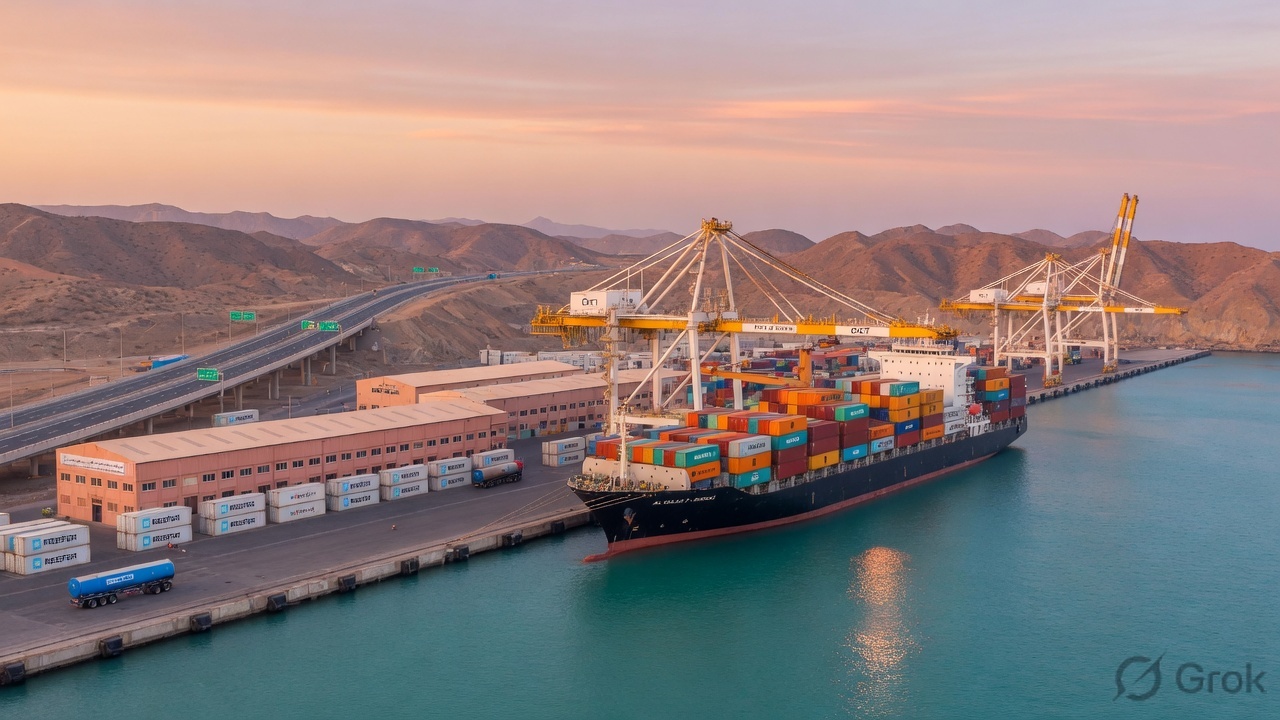
Oman is strengthening its position as a regional logistics and supply chain hub through strategic ports, free zones, transport infrastructure, and economic diversification. For eligible investors, the Oman Golden Visa can complement long-term investments in logistics-related sectors by providing renewable residency alongside opportunities to participate in the country's expanding trade ecosystem.
Introduction
Global supply chains have changed significantly over the past few years. Businesses are now more focused on resilience, alternative shipping routes, diversified suppliers, and regional distribution hubs rather than relying on a single market or transport corridor.
The GCC has become increasingly important in that shift, with governments investing heavily in ports, industrial zones, warehousing, and transport infrastructure. Oman stands out because of its direct access to the Indian Ocean and its position between GCC markets, South Asia and East Africa.
Its major ports at Salalah, Sohar, and Duqm collectively support around 200 weekly maritime services connecting Oman with 86 commercial ports across more than 40 countries. This network gives logistics businesses access to important Middle Eastern, Indian, and East African markets.
For investors, the opportunity extends beyond shipping. Warehousing, cold storage, freight forwarding, distribution centers, industrial logistics, and supply chain technology all sit within a broader ecosystem supported by Oman Vision 2040.
The Oman Golden Visa can complement these opportunities for qualifying investors seeking a long-term base in the country. It is not a dedicated logistics visa, but eligible business or investment structures may support Golden Residency when they meet the programme requirements.
Why Logistics Has Become One of the World's Fastest Growing Investment Sectors
Logistics has become a major investment sector because global trade, e-commerce and manufacturing increasingly depend on faster, more resilient supply chains. Countries with modern ports, reliable transport networks and strategic locations are therefore attracting more capital into warehousing, distribution and industrial infrastructure.
Businesses are also diversifying supply chains after experiencing disruption from pandemics, geopolitical tensions and shipping bottlenecks.
That has encouraged several trends:
- More regional warehouses and distribution centres
- Greater investment in cold storage
- Expansion of e-commerce fulfilment
- Nearshoring and regional manufacturing
- Increased demand for supply chain technology
- More focus on alternative ports and trade routes
For investors, logistics can provide exposure to several industries at once. Manufacturing, retail, food, healthcare, tourism and e-commerce all depend on efficient transport and warehousing.
Why Oman Is Emerging as the Logistics Gateway of the Middle East
Oman's geographic position is one of its strongest competitive advantages.
Unlike markets located deeper inside the Arabian Gulf, Oman has direct access to the Arabian Sea and Indian Ocean. This provides natural connectivity toward India, East Africa and major international shipping routes.
ASYAD highlights that the ports of Salalah, Sohar and Duqm are within roughly two weeks' sailing time of major global ports and provide rapid access to Middle Eastern, Indian and East African markets.
| Strategic Advantage | Benefit for Investors |
|---|---|
| Indian Ocean access | Easier connectivity with Asia and East Africa |
| Major deep-water ports | Supports large-scale shipping and industrial trade |
| GCC road connections | Access to neighbouring Gulf markets |
| Free zones | Supports manufacturing, warehousing and export businesses |
| Bonded corridors | Links ports with warehouses, airports and economic zones |
| Stable environment | Supports long-term investment planning |
| Vision 2040 | Positions logistics as part of economic diversification |
Oman's bonded corridors also connect the ports of Sohar, Salalah and Duqm with free zones, customs-bonded warehouses and international airports, helping goods move through the country more efficiently.
Oman Vision 2040 and the Future of Logistics
Oman Vision 2040 positions economic diversification, international trade and a stronger private sector at the centre of the country's development strategy. The Vision specifically highlights diversified imports and exports and greater integration with international markets.
Logistics is important because it supports almost every other growth sector.
Industrial development needs ports and warehouses. Tourism requires airports and distribution. Food security depends on cold chains. Manufacturing relies on efficient imports and exports.
Recent Vision 2040 implementation reporting also references transport and logistics tenders, showing continued attention to the sector.
For investors, this creates a broader opportunity than simply owning a warehouse or freight business. Logistics can sit at the centre of Oman’s manufacturing, food, tourism and trade expansion.
How the Oman Golden Visa Supports Long-Term Logistics Investors
The Oman Golden Visa offers renewable 10-year residency through seven approved investment options, with a minimum combined qualifying investment of OMR 200,000.
The programme is not specifically designed for logistics companies. Instead, investors may qualify through approved investment structures such as company investment, property, securities, fixed deposits or other eligible pathways.
For logistics investors, the benefit is long-term continuity.
A business owner establishing warehousing, distribution or freight operations may benefit from:
- Long-term residency
- Greater local presence
- Easier oversight of operations
- Family relocation
- More stable regional business planning
- Longer-term commitment to customers and partners
The residency should complement the investment rather than drive it. A logistics business must still be commercially viable, properly licensed and suited to the market.
Oman's Major Ports Driving Regional Trade
Oman's port network is one of the strongest foundations of its logistics strategy. Salalah, Sohar and Duqm form the core of the international freight system, while Port Sultan Qaboos has evolved toward tourism and mixed-use redevelopment.
Port of Salalah
Salalah sits directly on major east-west shipping routes and provides strong access to East Africa, South Asia and global maritime networks. Its location also supports the nearby Salalah Free Zone, which is positioned for logistics, manufacturing and export-oriented industries.
Port of Sohar
Sohar combines a major industrial port with a free zone and strong road access toward the UAE and wider GCC. This makes it attractive for manufacturing, metals, food processing, industrial logistics and regional distribution.
Port of Duqm
Duqm is closely tied to one of Oman's largest long-term industrial development projects. The surrounding Special Economic Zone supports logistics, commercial services, industry, tourism and maritime activities.
Port Sultan Qaboos
Located in Muscat, Port Sultan Qaboos historically played an important role in commercial trade. Its modern role is increasingly associated with tourism and waterfront development, making it less central to large-scale industrial logistics than Salalah, Sohar or Duqm.
Oman's major ports—including Salalah, Sohar and Duqm—support international shipping, industrial activity and regional trade while creating opportunities across warehousing, freight services and supply chain operations.
| Port | Strength | Industries | Investor Opportunities |
|---|---|---|---|
| Salalah | Indian Ocean and east-west shipping access | Logistics, manufacturing, food | Warehousing, distribution, freight |
| Sohar | Industrial and GCC connectivity | Metals, manufacturing, food | Industrial logistics, storage |
| Duqm | Long-term industrial growth | Energy, manufacturing, maritime | Warehousing, project logistics |
| Sultan Qaboos | Muscat location | Tourism and services | Hospitality-linked logistics |
Free Zones Supporting Logistics Investments
Oman's economic and free zones give logistics businesses another way to establish operations close to ports, industrial customers and export infrastructure.
Sohar Free Zone
Sohar Free Zone covers around 45 square kilometers and is closely integrated with the surrounding industrial and port ecosystem.
It can suit manufacturing, warehousing, food processing, and regional distribution operations.
Salalah Free Zone
Salalah benefits from direct Indian Ocean access and proximity to Port of Salalah. This makes it relevant to companies serving Africa, South Asia, and global shipping routes.
Duqm Special Economic Zone
Duqm supports commercial, industrial, logistics, and tourism activities and provides space for larger-scale operations.
| Free Zone | Main Industries | Logistics Benefits |
|---|---|---|
| Sohar | Manufacturing, metals, food | Port integration and GCC road access |
| Salalah | Logistics, manufacturing, export | Indian Ocean connectivity |
| Duqm | Industry, energy, maritime | Large-scale land and port access |
OPAZ oversees these zones as part of a wider network of special economic zones, free zones and industrial cities.
Logistics Investment Opportunities in Oman
Investors can participate in the logistics sector in several ways.
Warehousing and Distribution
Warehouses positioned near industrial areas, ports and major cities can serve manufacturers, retailers and importers.
Cold Storage
Food security, fisheries, pharmaceuticals and fresh-food distribution all require temperature-controlled logistics. OPAZ has also highlighted an integrated cold-chain economic cluster in Duqm linked to food and fisheries supply and export chains.
Freight Forwarding
Freight forwarding businesses coordinate shipping, customs, transport and documentation between suppliers and customers.
3PL and 4PL
Third-party logistics companies manage transport, warehousing and fulfilment for customers, while fourth-party logistics providers coordinate wider supply chain networks.
E-commerce Fulfilment
Online retail creates demand for inventory management, fulfilment centres and last-mile delivery.
Industrial Warehouses
Industrial zones create demand for storage of equipment, raw materials, spare parts and manufactured goods.
Supply Chain Technology
Digital platforms can improve freight tracking, fleet utilisation, customs processing, warehouse management and route planning.
The strongest opportunities are generally those supported by real customer demand rather than infrastructure growth alone.
Infrastructure Supporting Logistics Growth
Oman's logistics ecosystem extends beyond ports.
ASYAD's bonded corridors connect major ports with customs-controlled warehouses, free zones and airports, helping integrate sea, road and air freight.
Investors may also benefit from:
- Highway connectivity between major cities and GCC borders
- Industrial roads serving economic zones
- Airports supporting air cargo
- Digital customs systems
- Warehousing networks
- Logistics technology
- Future rail connectivity where projects are implemented
Rail should be viewed as an evolving opportunity rather than assumed infrastructure. Investors should base decisions on confirmed project timelines and operational assets.
Industries Creating Demand for Logistics Services
Logistics demand is rarely created by logistics companies alone.
Manufacturing → raw materials, industrial storage, exports Food & Beverage → cold chains, distribution, warehousing Healthcare → pharmaceutical storage and controlled transport Mining → heavy transport and industrial logistics Retail → inventory and distribution centres Tourism → food, hospitality and consumer supply chains Construction → equipment and building-material movement E-commerce → fulfilment and last-mile delivery Energy → project cargo and specialist transport
This diversity is one reason logistics can be an attractive long-term sector: growth in several parts of the economy can create demand for logistics services.
Why Global Investors Are Diversifying Supply Chains Through Oman
Many international companies are diversifying supply chains by creating multiple regional hubs rather than relying on one port, country or supplier network. Oman's location, infrastructure and trade connectivity make it relevant for businesses seeking greater resilience and access to GCC, African and Asian markets.
Oman can offer an alternative or complementary base to larger Gulf logistics markets.
The main advantages include:
- Direct Indian Ocean access
- Multiple major ports
- Connections with India and East Africa
- GCC road access
- Free zones and industrial areas
- Bonded logistics corridors
- A stable long-term development strategy
Supply chain diversification does not necessarily mean replacing Dubai, Saudi Arabia or another existing hub. In many cases, Oman may work best as an additional node in a broader regional network.
Risks Logistics Investors Should Evaluate
Like any infrastructure-related sector, logistics carries real investment risk.
| Risk | Impact | Mitigation |
|---|---|---|
| Weak customer demand | Low warehouse occupancy or freight volume | Validate demand before investing |
| High operating costs | Lower margins | Build realistic financial projections |
| Infrastructure delays | Delayed business growth | Depend on operational assets where possible |
| Competition | Pricing pressure | Choose a specialised niche |
| Regulatory change | Compliance costs | Maintain legal and regulatory monitoring |
| Customer concentration | Revenue instability | Build a diverse customer base |
| Low liquidity | Difficult investment exit | Review exit options before committing |
Investors should avoid assuming that growth in Oman's logistics sector means every warehouse, freight company or industrial asset will perform well.
Due Diligence Checklist for Logistics Investors
Before committing capital, investors should review:
- ✅ Business feasibility
- ✅ Customer and market demand
- ✅ Distance to ports and highways
- ✅ Port and shipping connectivity
- ✅ Free-zone or mainland regulations
- ✅ Warehouse occupancy assumptions
- ✅ Financial projections
- ✅ Licensing and customs requirements
- ✅ Labour and operating costs
- ✅ Legal ownership structure
- ✅ Insurance requirements
- ✅ Exit options
Due diligence should cover both Golden Visa eligibility and the commercial quality of the investment.
Illustrative Investment Scenarios
The following examples are illustrative only and are not actual client cases.
Warehouse Operator Expanding Into Oman
A regional warehousing business leases or develops facilities near Sohar to serve industrial customers and GCC distribution routes. The investor validates anchor customers before expanding capacity.
Indian Exporter Establishing GCC Distribution
An Indian food company establishes an Oman distribution centre to serve Oman and neighbouring Gulf markets. Cold storage and port access become central to the operating model.
Cold Storage Investment
An investor develops temperature-controlled storage serving fisheries, food importers and pharmaceutical distributors. The commercial case depends on contracted demand rather than general sector growth.
Regional Logistics Company Using Oman as a Hub
A freight company adds Oman to an existing UAE and Saudi network, using Salalah for Indian Ocean trade and Sohar for selected GCC routes. Oman becomes a complementary hub rather than replacing existing operations.
Oman vs UAE vs Saudi Arabia - Logistics Investment Comparison
| Factor | Oman | UAE | Saudi Arabia |
|---|---|---|---|
| Port access | Strong Indian Ocean and Gulf access | Highly developed global network | Large and expanding port network |
| Free zones | Strong sector-focused zones | Highly mature ecosystem | Growing logistics and industrial zones |
| Strategic location | Strong for India and East Africa | Strong global connectivity | Strong for domestic GCC scale |
| Market size | Smaller domestic market | Medium, highly international | Largest GCC domestic market |
| Logistics opportunity | Industrial, maritime and cross-border | Mature regional hub | High-growth domestic and regional expansion |
The UAE remains the region's most mature international logistics centre, while Saudi Arabia offers significant domestic scale. Oman offers a different proposition: direct Indian Ocean access, strategic ports and room for expansion across specialised logistics and industrial activities.
Frequently Asked Questions
How Migrate World Supports Logistics & Supply Chain Investors
Logistics investment decisions involve more than choosing a warehouse, port or free zone. The investment structure, residency pathway and long-term commercial plan need to work together.
Migrate World can support qualifying investors with:
- Golden Visa eligibility and residency planning
- Investment pathway guidance
- Business setup coordination
- Documentation support
- Family residency planning
- Strategic consultation around suitable investment structures
Where specialised legal, tax or financial analysis is required, investors should also work with qualified professionals before committing capital.
The goal is to ensure the investment makes sense both commercially and within the Oman Golden Visa framework.
Book a consultation with Migrate World to explore how eligible investments in Oman can align with your long-term business expansion and residency goals.
Conclusion
Oman's logistics ecosystem is developing through a combination of ports, free zones, industrial investment and long-term economic diversification. Salalah, Sohar and Duqm give the country direct access to major shipping routes and growing markets across the GCC, India and East Africa.
For logistics and supply chain investors, opportunities can extend across warehousing, cold storage, freight forwarding, distribution, industrial logistics, and supply chain technology.
The Oman Golden Visa can complement those opportunities by providing qualifying investors with renewable long-term residency through approved investment pathways. It should not, however, be the only reason to invest.
Success still depends on commercial demand, infrastructure access, realistic financial planning and thorough due diligence. Investors who approach Oman with a clear business case—and not simply a residency objective—are more likely to build a strategy that works over the long term.
Exploring Logistics Investment with Oman Golden Visa?
Speak with Migrate World about ports, free zones, and qualifying investment routes that can support long-term logistics and supply chain plans in Oman.
Get a Free Consultation